Your DMS runs every night. Start the day knowing.
TopDown reads the reports your dealership already exports, judges every repair order, purchase order and deal against the standards you published, and hands each manager the documents that need attention before the drive opens. Move the needle during the month, not after it closes.
Your own demo rooftop in a minute, on your store's name and address, with DEX reading your website for the team. No integration project; a CSV export from CDK is enough to go live. Sample store password is topdown.
who in service is not performing?
In Service, 10 findings worth $5,102 this month. Brett Collins shows up more than once: internal labor unbilled on 2 documents, $735; and install labor uncharged on 9 documents, $1,040. Omar Diaz shows up three times: menu underbill on 8 documents, $392; four sets of tires mounted with no labor line, $756; and internal labor unbilled on 1 document, $350. Sam Rivera shows up more than once: install labor uncharged on 3 documents, $850; and labor discounted with no reason code on 5, $440. Jenna Park: menu underbill on 3 documents, $168, and six recall lines submitted under the warranty rate, $211. Open a name to see the documents behind it.
what should PO-44118 have cost?
PO-44118, bumper_paint on a 2021 Toyota Corolla LE, billed $400 against a $200 matrix. Expected $202 to $258, median $230 (price book, regional survey, as of 2026-07). It is evidence on Jordan Hale approved 4 recon invoices over matrix.
what specials are my competitors running?
From the sweep this morning: Coastal Honda of Delray posts a synthetic oil change at $90 against your menu at $99, through the 30th. Federal Highway Tire & Brake is at $70 on the same line. On rate you post $189; the market I can see runs $199 (inferred), $175 and $169, so you sit 2 of 4. Match the oil change with a dated coupon, or make sure the advisors can say what the extra buys.
look up Brett and tell me what he sells the most and the least
Brett Collins, Service Advisor, in 2026-08: 11 repair order lines, $2,132. Most often: ACC-LINER, all-weather floor liners, 8 times, $1,490. Least often: BRK-CAL, RF caliper bracket service, 1 time, $44.
The month is still open. So is the chance to fix it.
A financial statement tells you what happened after it is too late to change. TopDown reads yesterday's paperwork tonight, so the manager whose name is on it hears about it tomorrow morning, while the vendor can still be re-bid and the advisor can still be coached.
The export lands
Your DMS scheduler, a shared folder or an email rule drops the day's CSV in the store's folder. Nobody uploads anything.
Every document is judged
Each repair order, purchase order and deal is checked against the menu, the matrix and the rate sheet the store published. Bad rows are reported, not fatal.
The ground around you
DEX reads what every competitor you named is posting, the events, the weather, the road work, the local economy and the factory's recalls, then measures it against the rate and menu you set. What changed, where you stand, what to adjust.
The morning brief
Each manager gets an email with what names their people, in dollars, with a link to the documents. The general manager gets the store.
DEX knows the ground your store stands on.
The numbers you set live in a market: the rooftops within ten miles posting their own specials, a festival closing the main road on Saturday, a storm on Thursday, a recall that fills the drive next week. None of that is in the DMS. Every night DEX goes and reads it, then measures it against your rate and your menu.
THIS MORNING · THE GROUND AROUND THE STORE
DEX reads every document in the store at once. Nobody else can.
A general manager can pull one report at a time. DEX has all of them, already judged, and answers in sentences: who is not performing, what a purchase order should have cost, what an advisor sells the most. Every number it says is on a document it can show you. If it has to guess, it says so instead.
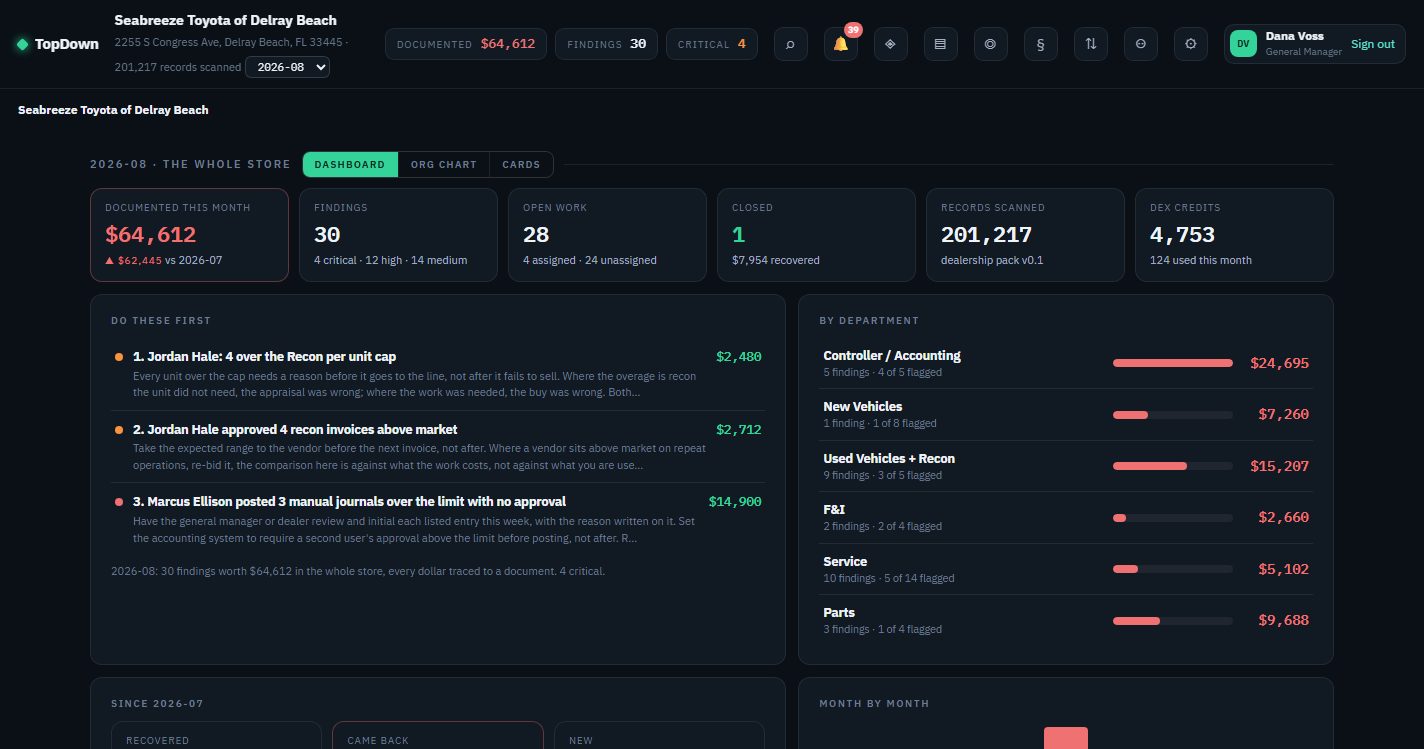
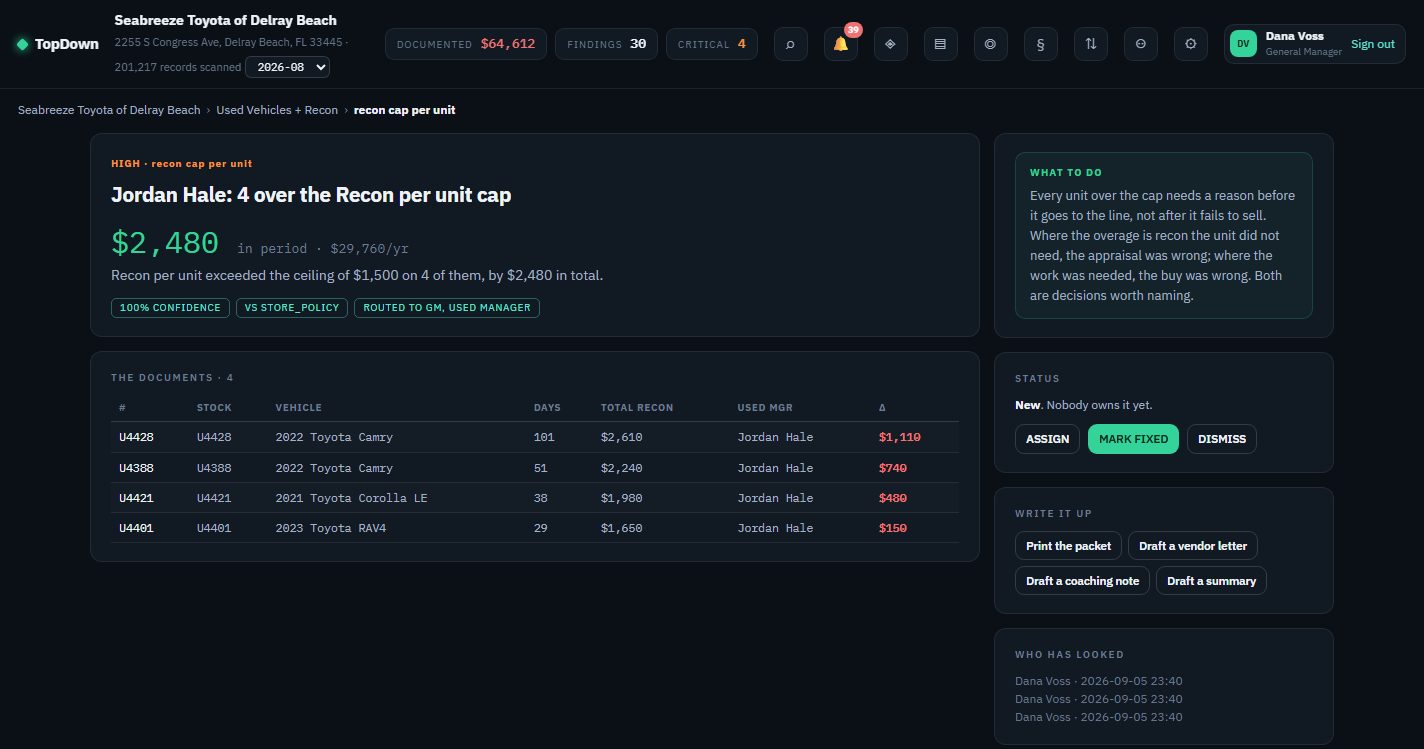
Every finding names the document.
Not "recon cost is high". Four stock numbers, the days each sat, the recon on each, the manager who approved it, and the dollars over the cap the store set for itself. The counterparty wrote the rule, which is what makes it hard to argue with.
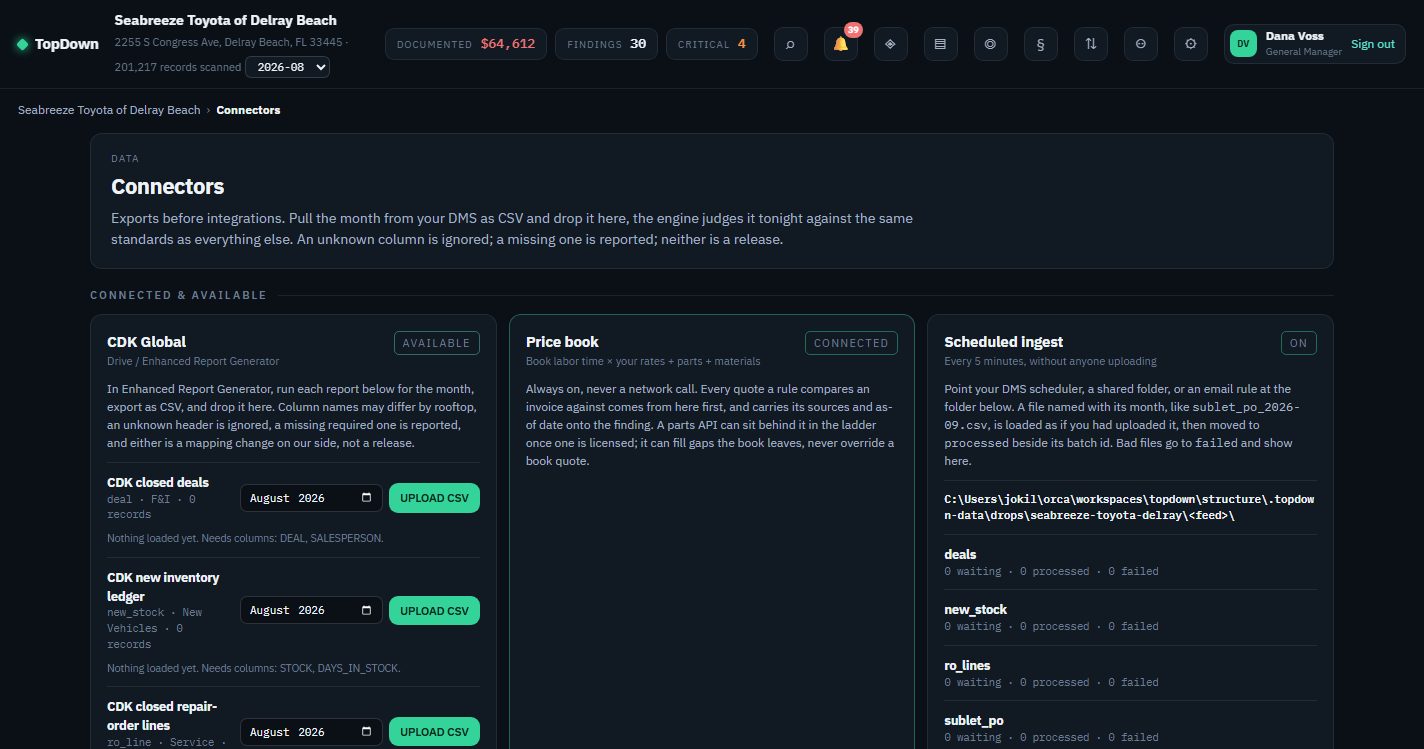
Exports before integrations.
A general manager can already pull these reports. TopDown reads them as they come, with a header dictionary per system that lives as data, so a rooftop whose export says PO NBR instead of PO NUMBER is a one-line change on our side.
Names are not the secret. Write-ups are.
SEABREEZE AUTO GROUP · WHO SEES WHAT
Document-level exceptions against the standards the store set for itself.
Each one is a rule in the dealership pack, data rather than code, with the record kind it reads, the standard it compares against, and the playbook that closes it.
Service
READS ro_line- Menu service billed under the published price with no override on file
- Internal repair closed with flagged hours and no labor sale
- Accessories or tires installed with parts billed and no labor
- Customer-pay labor discounted with no reason code
- Warranty lines submitted under the factory-approved rate
- A technician flagging far past standard time on customer-pay work
Used and recon
READS sublet_po · recon_summary- Recon paid above the published matrix
- Recon paid above market for the operation: a $1,400 set of tires, a $1,850 door skin
- The matrix itself priced above market
- Recon invoiced after the unit was sold
- Body work sent outside while the store runs its own body shop
- Units held past the turn policy
- Store-authored: recon per unit over cap, sublet PO over $500 with no approval
F&I and accounting
READS deal · deal_edit · gl_entry- Deals delivered under the back-end gross floor, by F&I manager
- Deal gross changed after the contract funded, with no approval
- Manual journal entries over the approval limit with no sign-off
- Contracts in transit past the funding policy, priced at the floor plan rate
- Factory rebates on delivered deals never submitted
Parts and new vehicles
READS part · parts_ticket · new_stock- Inventory with no sale in over a year, named as a bin so it never falls off a people view
- Counter tickets sold under cost, by counterperson
- New units held past the new-car age policy
Two tiers per rooftop. A founding rate for the first twenty.
Core buys the engine, every finding, the morning email, every seat and every screen. DEX Intelligence is the tier that calls a model, with credits included and metered per call, so you see exactly where they went.
Core, $1,495 a month per rooftop
THE FIRST TWENTY ROOFTOPS: $995, LOCKED TWO YEARS- The nightly run over every document, every finding, outcomes month over month
- The morning email to every manager, scoped to what they can see
- Every seat, the org chart, connectors, standards, the group view
- DEX on your own documents: findings, people, standards, narrated without a model call
DEX Intelligence, $495 a month
5,000 CREDITS INCLUDED · PACKS OF 1,000 FOR $50 BEYOND- Agent mode: questions that need judgment, answered from scoped tools with citations
- Web research from your city, drafts, the brief in prose, the nightly Area Intel sweep
- A question is about 11 credits; the allowance is roughly 450 of them. One credit is 1,000 tokens in or 200 out; every call is on the ledger with what it was for
- Request it, or a pack, under Settings; it is invoiced, and it lands when the invoice goes out
Groups
ONE CONTRACT, ONE INVOICE, EVERY ROOFTOP ON THE SAME RULES- Ten or more rooftops, 15% off
- Fifty or more, 25% off
- The group owner reads every rooftop as its general manager would, and the same rule ranked across all of them
Certified DMS connector
OPTIONAL · AT COST PLUS $150 A MONTH- For groups that want it. Exports remain the default and cost nothing
- A connector emits the same nightly batch as a parsed export; nothing downstream knows the difference
- Every contract grants anonymized benchmarking rights
Straight answers.
Do I need an integration project to start?
No. Export a few reports from your DMS as CSV and upload them on the Connectors screen, or point a scheduler at the store's drop folder. CDK's dictionary ships today; any other system is mapped against one month of your exports, on our side.
What does "every night" actually mean?
Whatever lands in the drop folder is loaded on a timer and judged the same way an upload is. The morning email goes out once a day, per store, at the hour you set. Nothing waits for the month to close.
Where do the "should have cost" numbers come from?
A price book: book labor time at your own rates plus parts and materials, with the survey or cohort it came from and the month it was good on. Those sources travel onto the finding. If the book has nothing for an operation, the finding says nothing rather than guessing.
Can DEX make things up?
It is not allowed to. Every dollar DEX says has to appear in a tool result: a finding, a document, a sourced web figure. An answer that fails that check is thrown away and the plain narrator answers instead. The same rule applies to the drafts it writes.
Who sees what?
Each login has an access level (view, act, administer) and a scope (which departments). A manager sees their departments plus any finding that names them. A group owner sees every rooftop in the group. Anything you cannot open tells you who can.
Can I ask DEX anything?
Anything about running the store: its documents, its people, its standards, its market and the area around it. A poem, a script, a diagnosis or a question about somebody else's business gets one sentence back and costs nothing. Each question has a credit ceiling and each login a daily allowance, so a curious afternoon cannot drain a pack.
What does it cost?
$999 a month per rooftop for founding members, with 1,000 DEX credits to start. Packs of 1,000 credits are $50, requested under Settings and invoiced. The nightly analysis, the findings and the morning email never spend a credit.
Is the demo store real?
It is synthetic. The rooftop, its group, its people, its vendors and its competitors are fictional, and every web source in the demo's Area Intel points at the demo host. The two hundred thousand documents a month are generated clean around the forty-nine that carry the story. The figures on this page are the engine's actual output on that store; sign in as any of the logins below and you will find them.
Your store's name on the door. DEX sets the rest up.
Leave the dealership and its address and you get a rooftop of your own: three sample months, an org chart, a morning brief, and Area Intel on the ground around your address. Give the website and DEX reads it for the people who run the store and puts them in their seats. Nothing found, nothing lost: the demo's chart stands in.
START YOUR DEMO
Or open the sample store and ask DEX about it.
Six logins, one group, one rooftop, forty-three seats, three months, two hundred thousand documents. Password for all of them: topdown.
hmarsh@seabreezeauto.comGroup owner, every rooftopdvoss@seabreezedelray.comGM, the whole storektran@seabreezedelray.comService manager, servicejhale@seabreezedelray.comUsed manager, used and what names himmellison@seabreezedelray.comController, accounting and what names himvromero@seabreezedelray.comParts manager, parts